The Science Behind a Mineral Terrarium
It All Begins Here
Why the layers matter, how to care for it, and what your plants need
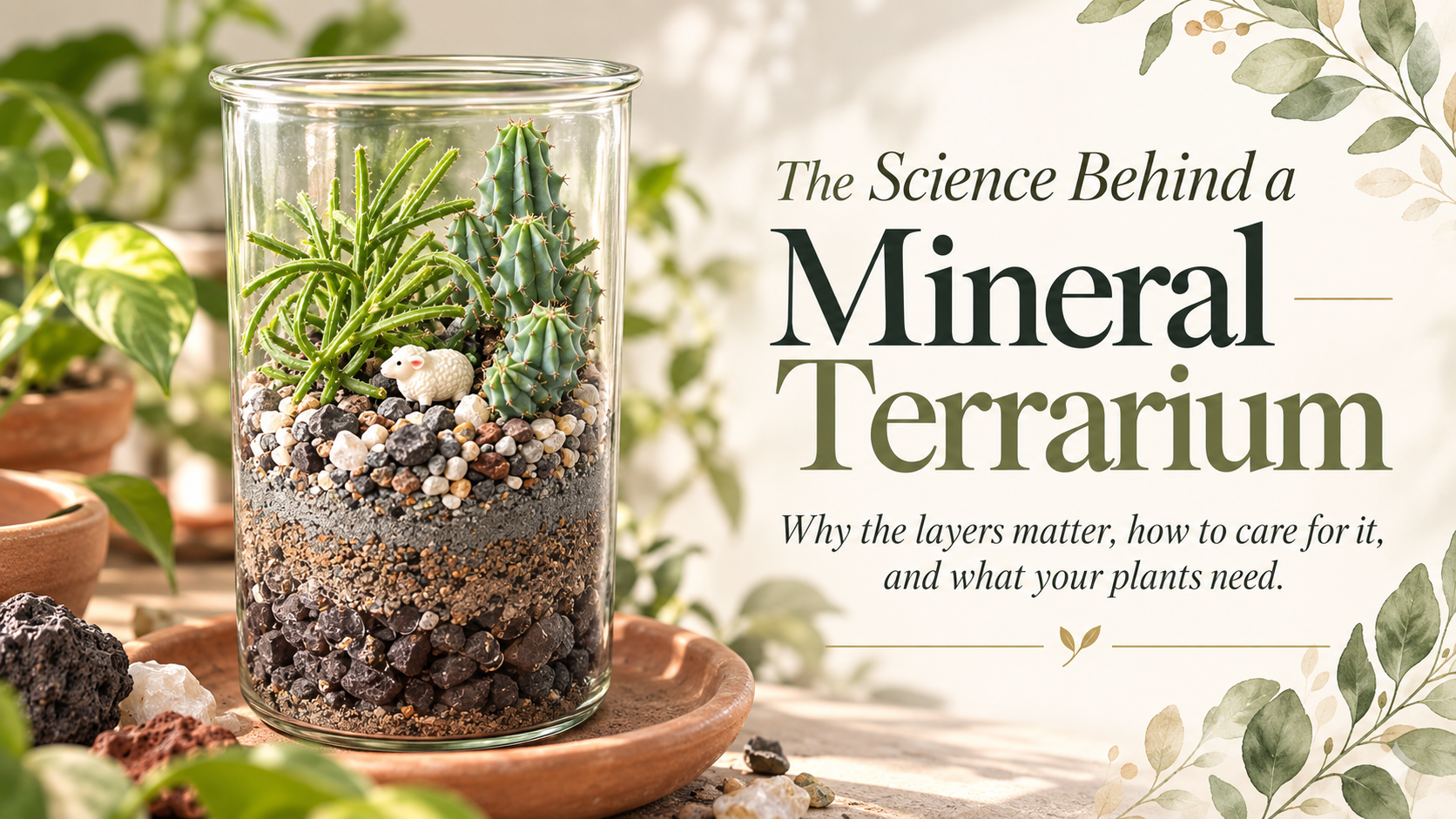
At Little Garden Gemz, we like a terrarium that is beautiful above the surface and sensible below it. Beneath the cactus, beneath the succulent, beneath every pebble sitting neatly in its place, there is another little world at work. Sand holds. Stone breathes. Water wanders. Roots go searching. Our terrariums use a mostly mineral-based growing system made from arena sand, black lava fines, red lava fines, and coarser stone. Those visible layers are not just decoration. Different particle sizes create different spaces for air and water to move through.
Succulent roots need moisture, but they also need oxygen. In a glass vessel with no drainage hole, that balance matters even more because every drop of water stays inside until the plant uses it or it evaporates. The coarser stones create larger pockets of air and allow water to move more freely. Lava fines are smaller and porous, so they hold a light film of moisture across their surfaces. Arena sand has even smaller spaces between particles, where capillary action helps move and hold water.
That is why we layer the materials instead of mixing everything together. If all the fine particles settled into the spaces between the larger stones, the system could become more compact and hold less air. But one thing is worth remembering: Rocks do not magically create drainage. There is still no hole at the bottom of the glass. Careful watering remains the most important part of the entire system. Lava rock may be mineral-rich geologically, but it is not complete plant food. Think of the substrate as the plant’s physical home rather than its dinner. It supports the roots, manages moisture, and keeps air moving, but the plants still need occasional nutrition.
We recommend a complete cactus or succulent fertilizer at about ¼ strength every six to eight weeks during active growth. More is not better. Because there is no drainage hole, fertilizer salts can slowly build up inside the terrarium as water evaporates. Care is simple: give the terrarium bright indirect light or gentle morning sun, water sparingly, and look through the glass before watering again. If the deeper layers still appear damp, wait. If water remains pooled at the bottom for a long time, the terrarium has received too much. Over time, the layers may shift. Sand may wander into the gravel. Lava fines may settle between larger stones. Roots may push their way through boundaries that once looked perfectly neat.
That is normal. A terrarium does not need to be rebuilt simply because the layers are no longer perfectly straight. Refresh it when the plants outgrow the vessel, salts or algae build up heavily, roots become crowded, or the lower layers continually stay wet for too long.
The best part of a clear terrarium is that it teaches you how it works. You can see moisture move. You can see the substrate dry. You may even see roots exploring their tiny mineral landscape. Instead of watering because a certain day has arrived, you begin watering because the terrarium itself is showing you what it needs. Big particles create space. Small particles hold and move moisture. Porous lava creates surface area. Roots explore. Water comes and goes. And within that little glass world, there is geology, weather, hunger, thirst, and growth.
Little Garden Gemz
Plants, creativity & experiences rooted in nature.

Collecting Pollen for Future Crosses
It All Begins Here
There comes a moment in the garden when a flower opens, bright as a tiny lantern, and seems to say, Now, now, now—if you want me, now. That is the trouble with pollen. It keeps the flower’s own clock. So when one Mestoklema is blooming and another possible parent is still sitting stubbornly green and silent, I collect what I can and save it for another day. With a clean, dry tool, I gently gather the pollen from the open flowers and place it into a small labeled vial. But there is one rule above all others: No wet pollen. No damp vial. No tiny swamp in a bottle.
Moisture is the enemy here. Pollen collected after rain, misting, heavy dew, or while the flowers themselves are damp can lose viability more quickly. Worse, trapping moisture inside a sealed vial creates the sort of little enclosed world that mold and microbes find quite agreeable. And what is agreeable to mold is generally disagreeable to a breeding program. So the pollen must be dry before it is sealed away.
Once collected, I give it time to dry under clean conditions, then label the container with the plant name and collection date. That tiny label may seem unimportant now, but months later it becomes the difference between knowing what you crossed and merely having an interesting mystery.
For short-term storage, the sealed pollen can be kept refrigerated. For longer storage, freezing may extend its useful life, although pollen behaves differently from species to species. There is no promise that every grain placed into cold storage will awaken months later ready for duty. That uncertainty is part of the experiment.
Dryness remains important even in storage. A desiccant can help keep the surrounding storage environment dry, provided the pollen itself is protected and kept clean. Then comes one of the easiest mistakes to make. When I remove a vial from the refrigerator or freezer, I do not open it immediately. A cold vial opened into warm air can gather condensation almost at once. Suddenly the carefully dried pollen meets water again—the very thing all this trouble was meant to avoid. Instead, I leave the vial sealed until it reaches room temperature.
Only then do I open it. Someday, perhaps, another Mestoklema will flower at just the right moment. Then this little vial will come back out, the stored pollen will meet a receptive stigma, and the experiment will begin again. Perhaps nothing will happen. Perhaps a capsule will form. Perhaps there will be seed. And perhaps one of those seeds will grow into something neither parent has ever been before. That is the strange scale of plant breeding: a future plant, a future generation, an entire possibility—waiting quietly in a speck of dust.

Turn Intention Into Action
It All Begins Here
Confidence doesn’t always arrive with a bold entrance. Sometimes, it builds quietly, step by step, as we show up for ourselves day after day. It grows when we choose to try, even when we’re unsure of the outcome. Every time you take action despite self-doubt, you reinforce the belief that you’re capable. Confidence isn’t about having all the answers — it’s about trusting that you can figure it out along the way.
The key to making things happen isn’t waiting for the perfect moment; it’s starting with what you have, where you are. Big goals can feel overwhelming when viewed all at once, but momentum builds through small, consistent action. Whether you’re working toward a personal milestone or a professional dream, progress comes from showing up — not perfectly, but persistently. Action creates clarity, and over time, those steps forward add up to something real.
You don’t need to be fearless to reach your goals, you just need to be willing. Willing to try, willing to learn, and willing to believe that you’re capable of more than you know. The road may not always be smooth, but growth rarely is. What matters most is that you keep going, keep learning, and keep believing in the version of yourself you’re becoming.

Make Room for Growth
It All Begins Here
Confidence doesn’t always arrive with a bold entrance. Sometimes, it builds quietly, step by step, as we show up for ourselves day after day. It grows when we choose to try, even when we’re unsure of the outcome. Every time you take action despite self-doubt, you reinforce the belief that you’re capable. Confidence isn’t about having all the answers — it’s about trusting that you can figure it out along the way.
The key to making things happen isn’t waiting for the perfect moment; it’s starting with what you have, where you are. Big goals can feel overwhelming when viewed all at once, but momentum builds through small, consistent action. Whether you’re working toward a personal milestone or a professional dream, progress comes from showing up — not perfectly, but persistently. Action creates clarity, and over time, those steps forward add up to something real.
You don’t need to be fearless to reach your goals, you just need to be willing. Willing to try, willing to learn, and willing to believe that you’re capable of more than you know. The road may not always be smooth, but growth rarely is. What matters most is that you keep going, keep learning, and keep believing in the version of yourself you’re becoming.